- I may receive a commission if a reader signs up for one of the credit cards mentioned in this post through my referral link. It helps me keep giving out lots of valuable info for free, so thank you in advance!
- I am not a licensed financial adviser, and this content is for informational purposes only. Readers are responsible for their own financial decisions.
SECTION 1: WHAT IS CREDIT CARD TRAVEL HACKING?
High-Level Executive Summary
Credit card travel hacking is the strategy of using credit card rewards and loyalty program partnerships to travel for a fraction of the cost — sometimes almost free.
At its core, it’s a system: you earn points and miles through responsible spending, convert those points into airline miles or hotel points, and then redeem them for flights, hotel stays, upgrades, and luxury travel experiences that would normally cost thousands of dollars.
But despite the word “hacking,” nothing about it is illegal, shady, or risky when you do it correctly. You’re simply taking advantage of programs the banks and airlines already want you to use — and using them better than the average person ever will.
For example:
A round-trip business class flight to Europe might cost $6,000+ in cash.
But by using one or two good credit card strategies, that same seat might cost you 70,000 points and $5–$200 in taxes and fees.
That’s the entire game: massive value in exchange for intentional behavior.
Want to stay informed about the travel hacking
game? Join the Wanderluxed mailing list.
Who It’s For
Credit card travel hacking is ideal for:
✦ People who REALLY love to travel
If you get excited about planning trips, daydream about far-flung destinations, or watch flight deals like they’re stock market tickers, this system is built for you.
✦ Curious, detail-oriented people
You don’t need to be a math whiz, but you do need a tiny spark of sleuthing energy. If the idea of discovering a hidden sweet spot or figuring out which airline partner offers the cheapest redemption gives you a little dopamine hit, you’re going to thrive.
✦ People who already spend money “normally”
This is incredibly important:
Travel hacking rewards normal spending — not extra spending.
If you pay for groceries, gas, subscriptions, travel, dining out, or business expenses anyway, you can redirect all of it onto a strategic credit card and let the points pile up.
✦ People who are financially responsible
You don’t have to be wealthy to do this.
You just need to be able to pay your cards in full every month.
Credit card debt kills the entire value of the strategy — so if you’re already good with money, you’re golden.
Who It’s NOT For
To be honest and transparent, credit card travel hacking is not the right fit for everyone. Some examples of folks who probably aren’t the best fit:
✦ People who truly value financial simplicity
If you want one card, one bill, one bank, and zero moving parts… this might feel like a chore, not a liberation.
✦ People who don’t enjoy travel
This sounds obvious, but you’d be surprised: if you don’t actually want to take trips, the rewards won’t feel motivating.
✦ People who can easily afford all the luxury travel they desire
If dropping $7,000 for a first-class flight is no big deal, points may not be worth your administrative time.
However, travel hacking can still save you tens of thousands of dollars a year and I can do it all for you if you’re interested in that service.
✦ People who carry credit card balances
This is crucial.
If you struggle to pay off a card every month, travel hacking will work against you.
The interest you’d pay would be more expensive than any flights you’d earn before maxing out your card.
Summary of This Section
Credit card travel hacking lets you turn everyday spending into premium travel experiences by using the rewards programs that banks and airlines already offer. It’s perfect for people who love travel, enjoy a good deal, and feel comfortable managing cards responsibly. It’s not ideal for people who dislike complexity or who prefer to keep their finances extremely streamlined.

SECTION TWO: TRAVEL CREDIT CARDS
Travel credit cards are the backbone of credit card travel hacking. They’re the engine that generates the points and perks you’ll later turn into flights, hotel stays, upgrades, and luxury travel experiences.
But not all travel credit cards are created equal, and the differences between them matter a lot. Choosing the right travel credit card (or the right combination of cards) determines how many points you earn, how flexible those points are, and how far those points can take you.
This section breaks down the major types, the pros and cons, the nuances most beginners miss, and the exact cards I recommend starting with.
Transferable Points Cards vs. Fixed Points Cards
Travel rewards cards fall into two major categories, and understanding this difference is one of the most important parts of the whole system.
1. Transferable Points Cards
These cards earn points that you can transfer to multiple airline and hotel partners.
Examples of transferable points “currencies” include:
-
Chase Ultimate Rewards
-
American Express Membership Rewards
-
Capital One Miles
-
Citi ThankYou Points
-
Bilt Rewards
For example, the Citi Strata Elite card earns Citi ThankYou Points that can be transferred to American Airlines Aadvantage miles, Emirates Skywards, Air France-KLM Flying Blue miles, Accor hotel points, and many more.
Why they matter:
✔ Maximum flexibility.
You can choose to transfer your points to whichever airline or hotel partner is offering the best deal at the moment you need to book.
✔ Access to sweet spots.
Many of the best value points redemptions in the entire world require booking a flight with a specific partner airline whose award chart is more favorable for your route than the airline you’ll actually be flying. Being able to transfer your points to a number of airline loyalty programs opens the door to finding these sweet spots. We’ll talk about these sweet spots in greater detail later.
✔ Ability to combine earning potential.
With cards that offer transferable points, you can make your miles go further. That’s because you can not only earn points through signup bonuses and daily spending, but you can also make them go farther with transfer bonuses, partners, and perks — all feeding into one big, flexible pool.
These cards are the foundation of powerful travel hacking because they adapt to any trip you want to take.
2. Fixed Points Cards
These cards are co-branded with a specific airline or hotel portfolio and they only earn rewards with that particular loyalty program.
Examples include:
-
The United MileagePlus Explorer card
-
The Citi Aadvantage World Elite Platinum Select Mastercard (what a mouthful!)
-
Marriott Bonvoy Boundless credit card from Chase
Why they matter:
✔ Useful for topping up your points or miles balance with a brand that owns a specific hotel you want to stay at or route you’re saving up to fly
✔ Great for beginners who want easy wins because they’re simple: you don’t have to worry about partners or award charts
✔ Helpful if you live near one of a specific airline’s hubs (e.g., Chicago for United or DFW for American Airlines)
These cards are especially useful for working toward specific aspirational trips.
Personal vs. Business Travel Credit Cards
Another key distinction is the type of credit card account:
Personal Travel Credit Cards
These are based on your personal credit score and Social Security number.
They earn points on everyday personal spending like:
-
Dining
-
Groceries
-
Travel
-
Subscriptions
-
Shopping
Most beginners start here.
Business Travel Credit Cards
These are available to:
-
Freelancers
-
Entrepreneurs
-
Online business owners
-
LLCs and S-corps
-
Anyone earning independent contractor income
Even tiny businesses qualify — if you sell on Etsy, Airbnb, Upwork, or run a side hustle, you likely already qualify.
Why business cards matter:
✔ Business expenses can stack points FAST
✔ Business cards often have higher signup bonuses (and higher minimum spending requirements to earn them)
✔ They typically don’t show up on your personal credit report, which helps with rules like Chase’s 5/24 rule (Chase won’t approve your application for a credit card if you’ve already opened 5+ cards in the last 24 months with ANY bank)
✔ Business cards often have killer multipliers on categories like advertising, shipping, and software (e.g., 3 points per dollar spent on social media ads)
Many advanced travel hackers earn more points from their business cards than their personal cards.
Annual Fees
Most high-value travel rewards cards come with annual fees between $95 and $895. That sounds like a lot… until you read the next section (Credits & Benefits) and see how much money these cards can save you.
For nearly all frequent travelers, these cards more than pay for themselves. Just be aware that your first monthly statement (and every twelfth monthly statement thereafter) will have an annual fee added.
These fees (and any other fees you might choose to incur like a cash advance fee, late fee, or foreign transaction fee) do not count toward the minimum amount you have to spend to qualify for the signup bonus (SUB). SUBs are earned through purchases only, not fees.
It’s worth noting that cards with annual fees rarely charge foreign transaction fees for purchases made in other currencies (so they’re ideal to use when you’re traveling overseas).
Credits & Benefits
Travel credit cards offer credits and benefits that can cover or exceed the cost of the annual fee. They also offer perks that can dramatically improve your travel experience.
Credits
- The Chase Sapphire Reserve card comes with a $300 annual statement credit that offsets any travel expense including purchases from any airline, hotel, Airbnb, Uber, or train/bus fare.
- The Citi Strata Elite card comes with $200 in annual statement credits that offset purchases from your choice of up to 2 of the following brands: 1stDibs, American Airlines, Best Buy, Future Personal Training, and Live Nation (Ticketmaster).
- The American Express Platinum card comes with $100 in statement credits each quarter (so $400/year) when you use your Platinum Card at restaurants booked with Resy.
Benefits
- Companion passes (e.g., the Southwest Companion Pass allows you to bring a designated companion on any Southwest flight for just the cost of taxes and fees—Alaska Airlines and British Airways have their own versions of this benefit)
- Free CLEAR membership, Global Entry membership, and/or TSA Pre-Check membership
- Travel insurance (trip cancellation and/or trip interruption coverage)
- Concierge services (assistance with making restaurant reservations, finding tickets to events, creating travel itineraries, handling shopping requests, etc.)
- Rental car insurance
Perks
-
Free checked bags
-
Airport lounge access
-
Hotel elite status
Altogether, these credits, benefits, and perks can save you hundreds or even thousands of dollars per trip.
Want to stay informed about the travel hacking
game? Join the Wanderluxed mailing list.
Case Studies: Popular Travel Credit Cards
Here are detailed breakdowns of some of the most powerful cards on the market — and how they fit into a strong travel hacking setup.
Chase Sapphire Reserve
Annual Fee: $795
Effective Fee: You get paid over $1300 to have this card (after making up for the annual fee) if you maximize the credits. There’s a $300 annual travel credit, $300 in annual dining credits with Sapphire Reserve Exclusive Tables, $25/month in Doordash credits, free Apple TV, free Apple Music, $10/month in Lyft credits, $300 in annual credits for event tickets purchased on StubHub and viagogo, and $500 in annual statement credits for stays at Chase The Edit hotels (note that these are all pretty pricey hotels so you may not be able to use this benefit unless you’re springing for an expensive luxury stay).
Best For: Frequent travelers who want premium perks
Why it’s powerful:
-
3x points on dining
-
4x points on flights and hotels booked directly with airlines and hotels
-
Priority Pass lounge access (it’s a worldwide network of 1800+ airport lounges)
-
Excellent travel insurance
-
Ultimate Rewards transfer partners include United, Air Canada, Hyatt, Southwest, British Airways, and more
This is one of my personal daily drivers because it earns points incredibly quickly. It also gives cardholders automatic IHG One Rewards Platinum Elite status.
American Express Platinum
Annual Fee: $895
Effective Fee: Having this card pays you $625/year (after making up for the annual fee) if you maximize the $400 annual dining credit with restaurants booked on Resy; $300 annual digital entertainment credit good for Hulu, New York Times, Paramount+, and more; $100 annual Saks credits; $10/month Uber Cash; $600 annual hotel credits for Fine Hotels + Resorts or The Hotel Collection bookings made through Amex Travel (there are some mid-range options in these portfolios, not just aspirational properties, so I almost always use these credits in full).
Best For: Lounge lovers + luxury travelers
Key perks:
-
Centurion Lounge access
-
5x points on flights booked directly with airlines
-
$200 airline fee credit good for fees only (i.e., seat selection fees, onboard wifi, baggage fees, but not airfare) at one airline of your choice
-
Marriott Bonvoy Gold Elite Status
-
Hilton Honors Gold Status
-
Free CLEAR Plus and Global Entry
-
Strongest collection of transfer partners (20 airlines and 3 hotel portfolios)
This card is less about earnings (1x on most things) and more about lifestyle, luxury perks, and transfer partners like ANA, Emirates, and Singapore Airlines — which can unlock some of the best premium cabin redemptions in the world.
Capital One Venture
Annual Fee: $95
Effective Fee: $95
Best For: Beginners and people who want simplicity
Strengths:
-
2x points on everything
-
A good selection of transfer partners (Air Canada, British Airways, Qantas, Turkish Airlines, etc.)
-
Excellent if you want to redeem your points for statement credits to cover travel purchases at boutique hotels, hostels, ferries, trains, or other non-chain travel (note that the redemption value for your points when you use them like this is only 1 cent per point—almost as low as it gets, so I don’t recommend it)
This is one of the easiest cards for a travel hacking beginner to use successfully. If you use transfer partners instead of statement credits for redemption, it’s possible to get a value in the vicinity of 13 cents per point (more than respectable).
Citi AAdvantage World Elite Platinum Select Mastercard
Annual Fee: $99 (sometimes waived for the first year)
Effective Fee: $99
Best For: People who want to build a stash of American Airlines miles fast
Why it’s useful:
-
Usually offers a strong signup bonus (SUB)
-
Free checked bag on AA
-
Preferred boarding
-
2 miles for every $1 spent at restaurants, gas stations, and on American Airlines purchases
Since AA miles can be used to book flights on some insanely valuable partners (like Japan Airlines first class), this card is a sleeper hit. It’s currently in my wallet.
Chase Ink Business Preferred
Annual Fee: $95
Effective Fee: $95
Best For: Business owners (even small ones)
Highlights:
-
Offers a very respectable SUB (currently 90,000-100,000 Chase Ultimate Rewards points)
-
3x on travel, shipping, advertising, and internet, cable and phone services
-
Works with all 14 Chase Ultimate Rewards transfer partners
This card is a cornerstone of many advanced setups because of its significant SUB and high multipliers.
Which Cards to Start With (Beginner Roadmap)
I recommend beginners start with one of these two cards:
1. Chase Sapphire Preferred (CSP)
Annual Fee: $95
Effective Fee: $95 for the first year and $45/year thereafter (you get $50 in statement credits each account anniversary year for hotel stays purchased through Chase Travel).
Most people should start here because:
-
It earns Chase Ultimate Rewards (the best all-around starter points)
-
It unlocks transfers to Hyatt, United (who has some of the best award space availability in the industry, meaning it’s easier to find seats you can book with miles), Air Canada, British Airways, and more.
-
It’s simple and powerful
-
Chase’s 5/24 rule applies to it, so you want this card early (Chase won’t approve your application for a credit card if you’ve already opened 5+ cards in the last 24 months with ANY bank)
This is the single most recommended starter card in the travel hacking world — and for good reason.
2. Capital One Venture
Annual Fee: $95
Effective Fee: $95
Beginner-friendly because:
-
2x points per dollar spent on anything and everything
-
Easier learning curve for newbies
-
Redeem points directly (lower value) OR transfer them to partners
-
Helps beginners get wins fast
If the Chase system feels overwhelming, CapitalOne Venture is a softer landing because of its straightforward rewards, flexible redemption options, and solid benefits with a manageable annual fee.

SECTION THREE: HOW TO USE CREDIT CARDS TO EARN TRAVEL POINTS AND AIR MILES
Once you’ve chosen the right travel credit cards to start with, the next step is learning how to earn points intelligently and efficiently. Most people earn only a fraction of the rewards available to them simply because they don’t understand the systems credit card companies and airlines use to distribute points.
This section breaks down every major way to earn points — from the big, foundational sources to the lesser-known multipliers and stacking opportunities that dramatically accelerate your earnings. By the end, you’ll know how to make every dollar you spend work exponentially harder for you.
Credit Card Sign-Up Bonuses (SUBs)
The most important piece of credit card travel hacking.
Sign-up bonuses (SUBs) are:
-
The fastest way to earn large amounts of points
-
Often worth $750 to $10,000+ in travel
-
Responsible for 80–90% of the value most travel hackers get in their first year
How SUBs work:
-
You apply for a new travel card.
-
You meet the required minimum spending threshold (varies by card but often $3000-$10,000) within 3–6 months (again varies by card).
-
The bank awards you a large bonus — often 60,000 to 120,000+ points.
Example:
-
Chase Sapphire Preferred: Spend $5,000 in 3 months → Earn 75,000 bonus points
-
Amex Platinum: Spend $6,000-$8,000 in 6 months → Earn 100,000 – 175,000 points (offers vary by individual)
Those points alone can cover:
-
A round-trip business class flight to Europe in a seat that turns into a bed
-
5–10 nights at a Hyatt hotel
-
Multiple domestic trips
-
A luxury hotel stay worth thousands of dollars
SUBs add up much faster than daily spending.
You can earn points by spending normally… but nothing compares to sign-up bonuses.
Credit Card Earning Rates
Earn points from your everyday purchases.
Once your bonus is secured, your next move is maximizing how many points you earn from regular day-to-day spending.
Nearly all travel credit cards offer:
1. Base Earning Rates
Every purchase earns at least 1x point per dollar spent.
This may sound small, but over time it becomes substantial — especially when paired with multipliers.
2. Bonus Categories
Certain spending categories earn 2x, 3x, 4x, 5x points per dollar spent or more.
Examples:
-
Chase Sapphire Reserve: 3x points per dollar spent on dining & 4x points per dollar spent on flights & hotels booked directly with airlines and hotel properties
-
Amex Gold: 4x on dining & groceries + 3x on flights
-
Chase Ink Preferred: 3x on advertising, shipping & ALL travel purchases
-
Capital One Venture: 2x on EVERYTHING
Why this matters:
If you’re spending $20,000 per year across dining, groceries, travel, and subscriptions, a smart category strategy can earn 40,000–80,000 points annually without changing your budget at all.
Daily Spending Rule of Thumb
Switch every expense you possibly can from paying with cash/debit → to a travel credit card.
This includes:
-
Dining & takeout
-
Groceries
-
Uber/Lyft
-
Flights
-
Subscriptions (Netflix, Canva, software)
-
Gas & transportation
-
Hotels, Airbnbs, rental cars
-
Shopping (in-store or online)
Put simply:
If you’re not earning points on every purchase, you’re leaving money on the table.
With the BILT Mastercard, you can even earn (transferable) points for dollars spent on rent (without paying a transaction fee).
Want to stay informed about the travel hacking
game? Join the Wanderluxed mailing list.
Multipliers: The Secret to Rapid Point Growth
This is where beginners often get overwhelmed — but it’s also where the fun begins. Multipliers allow you to earn points on top of the points from your credit card spending.
Here are the big four:
1. Online Shopping Portals & Apps
Most major airlines, hotels, and banks operate online shopping portals. When you start your purchase through one of these portals, you earn extra points in addition to what your credit card gives you.
Example:
-
Chase Ultimate Rewards Shop & Earn: Earn +5x points per dollar spent at Home Depot
-
Rakuten: Earn 12x Amex Membership Rewards points at Lululemon, Lane Bryant, GAP, Expedia, Hotels.com, ULTA Beauty, Vrbo
-
AAdvantage eShopping: Earn 3x American Airlines miles per dollar spent at Sephora
-
United MileagePlus shopping: Earn 6x miles per dollar at Best Buy
This can easily add hundreds or thousands of extra points per month.
A typical beginner mistake:
Forgetting to use portals when buying things you were already going to buy anyway. I never buy anything online without checking evreward to see which portal is offering the most points for it.
2. Dining Programs
Many airlines run dining programs. You link your card once, and when you dine at participating restaurants, you earn bonus points automatically.
Examples:
-
American Airlines AAdvantage Dining
-
Delta SkyMiles Dining
-
United MileagePlus Dining
-
Southwest Rapid Rewards Dining
You earn:
-
1–5 points per dollar from the dining program
PLUS -
Points from the credit card you pay with
PLUS -
Stack points from the Seated app
- Sign up for both Seated and an airline’s dining program. Join your preferred airline’s dining program and link the same credit card you use for Seated.
- Dine at a restaurant on both lists. Look for restaurants that participate in both Seated and your airline’s dining program.
- Earn rewards from both. When you pay with your linked card, you can earn rewards through Seated while simultaneously earning miles from your airline program for the same transaction AND the points from the credit card you pay with.
A single $100 dinner can earn 300–800+ points.
3. Ride-Hailing Apps
Uber, Lyft, Grab (in Asia), and Bolt (in Europe) frequently partner with banks or airlines to offer point bonuses.
Examples include:
-
Uber → Chase Sapphire Preferred earns 2x points per dollar spent and Chase Ink Business Preferred earns 3x
-
Lyft → Chase Sapphire Reserve earns 5x
-
Uber → Delta & Marriott partnerships (link your Delta or Marriott account in the Uber app and earn points in addition to the ones you’ll get from the credit card you pay with)
- Lyft → Atmos (Alaska/Hawaiian Airlines), United, Hilton, & Bilt partnerships (link your preferred loyalty account in the Lyft app and earn points in addition to the ones you’ll get from the credit card you pay with)
If you ride frequently, this adds up fast. It’s nice that this earning strategy is a “one and done” task: you just link a loyalty program with each ride-hailing app, add the card that offers the highest points per dollar spent with that app as your primary payment method, and forget about it.
4. Paid Travel Bookings
You can earn points twice when you book and pay for travel in cash instead of points/miles:
-
From the credit card you use (often 3x+ on travel)
-
From the platform you book through (sometimes big bonuses)
High-value examples:
-
12x Amex points per dollar spent on Hotels.com or Expedia using the Rakuten shopping portal
-
Rovemiles.com—Rove has 11 airline transfer partners like a bank. You can get tens of thousands of miles for one hotel stay if you book it through Rove.
-
Their rates do tend to be a little higher than you’d pay if you booked directly with the hotel. But you can get so many points for it that it’s often worth paying a little bit more.
-
For example, you can get enough points to book the same number of nights again at the same hotel for free. So it’s like getting to stay ten nights and only paying 10 or 20% more than the cost of staying five nights.
-
And of course, when you book a cash flight with your airline loyalty program number attached, you earn airline miles on top.
Putting It All Together: Earning Strategy Summary
To maximize points:
✔ Get the right travel cards
✔ Focus heavily on SUBs
✔ Use the best card for each spending category (dining, travel, groceries, etc.)
✔ Route your spending through online shopping portals
✔ Link all cards to dining programs
✔ Link your loyalty accounts with rideshare apps
✔ Book paid travel through multiplier portals and sites
When you combine these, your earning rates skyrocket.
Most people earn:
-
10,000–20,000 points per year using credit cards casually
Travel hackers earn:
-
100,000–500,000+ points per year without changing their lifestyle
-
Simply by optimizing how they spend the same money

SECTION FOUR: HOW TO REDEEM CREDIT CARD POINTS AND AIR MILES
Earning points is easy enough.
Redeeming them well is the hard part — and it’s where most beginners accidentally destroy most of the value they’ve built.
Done correctly, your points:
-
Are worth 5–20× more than cash back
-
Will buy you luxury flights that normally cost $5,000–$20,000
-
Are one of the most powerful financial tools available to travelers
But done incorrectly, your points drop dramatically in value — sometimes to just 0.5 cents per point, meaning you get pennies back for rewards that should be worth thousands.
This section walks you step-by-step through the entire redemption process so you can book flights and hotels like a pro.
Loyalty Programs: Your Key to High-Value Redemptions
Every major airline and hotel chain has a loyalty program, and this is where the magic happens. Instead of redeeming points directly through your bank’s travel portal or cash back/statement credit offer, you can transfer your credit card points to an airline or hotel partner and book travel there.
This is how people book:
-
First class suites
-
Business class lie-flat seats
-
High-end hotels
-
Multi-stop itineraries
-
Complex round-the-world trips
Before we get into advanced strategies, let’s start with the basics.
How to Book a Straightforward Award Flight (Beginner Walkthrough)
Most airline websites let you search for award flights the same way you search for paid tickets:
-
Go to the airline’s website
-
Select “Use Miles” or “Book with Points”
-
Enter your cities and dates
-
Compare options
You’ll see:
-
Flights priced in miles
-
Taxes/fees required in addition to the miles
-
Cabin classes available
Example:
A simple American Airlines search from New York → London might show options like:
-
Economy: 30,000 miles + $5.60
-
Business: 57,500 miles + $5.60
-
First: 110,000 miles + $5.60
Booking is usually straightforward — click, enter passenger info, and check out.
But this simple process is only the beginning.
Airline Alliances: The Most Important Travel Hack You Can Learn
Airline alliances are partnerships that allow airlines to sell seats on one another’s flights.
There are three major alliances:
1. Star Alliance
United, Lufthansa, SWISS, Air Canada, ANA, Turkish, Singapore, etc.
2. Oneworld
Alaska Airlines, American Airlines, British Airways, Qatar, Qantas, JAL, etc.
3. SkyTeam
Delta, Air France, KLM, Korean Air, Virgin Atlantic, etc.
Why alliances matter:
✔ You can use miles from one airline to book flights on any partner airline
✔ Partner airlines often price the same seat for significantly fewer miles
✔ Taxes and fees can vary wildly
✔ Some airlines offer “sweet spots” with partners you wouldn’t expect where redemptions are exceptionally valuable
Sometimes the exact same flight (in the exact same cabin on the exact same plane) is sold by different partners for very different rates:
Flying AA business class from Atlanta → Philadelphia → Barcelona on 19 February (AA 5015 + AA 742) is priced as:
-
55,000 Alaska/Atmos points + $18.10
-
70,000 American Airlines miles + $5.60
-
82,100 Qantas miles + $238.50
Exact same flights. Very different pricing.
And sometimes the difference isn’t tens of thousands but hundreds of thousands of miles.
This is why alliances matter.
Most beginners unknowingly waste 5+ figures in points per year because they redeem with the wrong partner.
Fixed Award Charts vs. Dynamic Pricing
There are two types of loyalty programs:
1. Fixed Award Charts (Usually The Best Value)
These airlines have set mileage prices based on:
-
Distance flown
-
Region
-
Cabin class
-
Season
Examples:
-
Japan Airlines (JAL): Business class US → Japan for 55,000 miles.
-
British Airways: First class Seattle → London for a flat 85,000 Avios in off-peak season
-
Hyatt Hotels: 18,000 points per night for category 4 in peak season, even during major events
Fixed charts = predictable, stable, and almost always the best use of points.
2. Dynamic Award Pricing (More Common Now)
These airlines adjust prices based on demand, similar to cash pricing.
Examples:
-
Delta (SkyMiles)
-
United (post-2020)
-
Most major hotel chains outside Hyatt
Dynamic pricing means:
-
Off-peak flights can be cheap
-
Peak flights can be insanely expensive
-
Miles required to book the same flight often fluctuate by the hour
Because of this volatility, travel hackers lean heavily on fixed-chart programs whenever possible.
Want to stay informed about the travel hacking
game? Join the Wanderluxed mailing list.
How to Find the Best Award Flight Redemption
Searching manually across many airlines can take hours and hours — so experts start with tools to make it faster. These tools have limitations—they can miss sweet spots, display award seats that aren’t really there, and don’t show every single airline. So they can’t replace research. But they can make it significantly faster.
They do this by comparing award space across multiple airlines, displaying partner pricing options, and identifying which types of transferrable points you can use to get miles in relevant programs.
The two most helpful tools:
1. PointsYeah
PointsYeah can sometimes display phantom award space (an award seat that is no longer available). ALWAYS check the airline directly before transferring credit card points.
PointsYeah also has a fairly limited multi-city search function. You can’t really use it for more than two flight segments at once. So if you’re doing a complete multi-stop route like a round-the-world trip, you’re going to want to get one month of a paid tool (see Seats.aero below).
Lastly, PointsYeah doesn’t cover every single airline, every single niche route, or every ultra-premium cabin. Sometimes it even temporarily can’t display award space on more major airlines. If any connections to specific airlines are currently down on PointsYeah, you will be able to see that on http://www.pointsyeah.com/systemstatus.
2. Seats.aero
The paid tool I recommend is Seats.aero. You can get one month of it for $9.99 and then cancel once you’ve found your next award flights.
The reason I use PointsYeah instead of Seats.aero’s free version as my starter tool is because the free version of Seats.aero only shows you award space in the next two months, whereas PointsYeah’s free version can look forward a whole year.
The pro version of Seats.aero for $9.99 a months also looks forward a year. It is lightning fast, and it is better at multi-stop routes and high-end redemptions than PointsYeah.
In summary, these tools don’t show everything. But they can save you lots time and can reveal deals you might miss if you’re searching manually.
Note that all the complexity of the LOYALTY PROGRAMS section above is why people use the strategies in the next two sections even though they are far less valuable. The banks rely on people to do this! But you can and should take advantage of the loopholes and exploit the advantages most people miss. The pay off is tens of thousands of dollars worth of luxury travel per year.
Travel Portals (Less Value, More Simplicity)
Every major bank offers a travel portal where you can redeem points as if they were cash:
-
Chase Travel (1.25–1.5 cents per point)
-
Citi Travel
-
Capital One Travel
-
Amex Travel
Pros:
✔ simple
✔ user-friendly
✔ you can book almost any flight/hotel instead of searching for award space
Cons:
✘ much lower value
✘ no access to premium cabin “sweet spots”
✘ often costs MANY more points to get the same seat than it would cost if you transferred points to an airline
People might use portals if:
-
They’re booking economy flights (still it should be noted they could get multiple economy flights for the same number of points they spend on booking a single economy flight via a bank’s travel portal, by transferring points as described in the LOYALTY PROGRAMS section above)
-
They want simplicity
-
They need to book something last-minute and there’s no award space
But for maximizing value?
Transferring points is pretty much always superior.
Statement Credits (The Lowest Value)
Using points to pay your credit card balance directly is hands down the worst redemption method. You’re trading research for value and the bank is winning the game.
Most banks give you:
-
0.5 to 1 cent per point
This cuts your points’ value by 70–90%.
I have never let go of my hard-earned points this way. And I would advise others to consider it only in emergencies or if you have leftover points you can’t transfer.
How to Maximize the Value of Your Points
Here’s the hierarchy, from worst to best (cpp = cents per point):
| Method | Typical Value |
|---|---|
| 5. Statement credit | 0.5–1 cpp |
| 4. Travel portals | 0.5–1.5 cpp |
| 3. Hotel programs | 0.5–3+ cpp |
| 2. Airline programs | 3–15+ cpp |
| 1. Premium cabin sweet spots | 5–25 cpp |
I have never spent points on anything but the top two tiers. To illustrate why, here’s an example.
Let’s say I’m trying to get from Chicago to Paris.
- Tier 1 redemption: I could spend 60,000 Chase Ultimate Rewards points (transferred to AirFrance Flying Blue miles) + $240.80 for a lie-flat seat in AirFrance business class (AF 137) on several different days in January (1st, 5th, 6th, 10th, 11th, 12th, 19th, 20th). That’s a one-way flight.
-
- This flight is $3708 if I buy it with cash, so I’m saving $3467.20 (and getting almost 5.8 cents per point).
- (1) ultimaterewardspoints.chase.com > Travel > Transfer Points to Partners, THEN (2) wwws.airfrance.us > Log in > Book With Miles
-
- Tier 2 redemption: I could spend 115,000 Chase Ultimate Rewards points (transferred to United MileagePlus miles) + $5.60 for a lie-flat seat in United’s Polaris business class (UA 987) two days from now (29 November 2025). That’s a one-way flight.
- This flight is $8341 if I buy it with cash, so I’m saving $8,335.40 (and getting 7.25 cents per point).
- (1) ultimaterewardspoints.chase.com > Travel > Transfer Points to Partners, THEN (2) united.com > Sign In > select the “Book with Miles” box in the Book tab
- Tier 3 redemption: I could spend 145,500 + $48.98 in tourist tax to stay at Hôtel National des Arts & Métiers in the Le Marais district of Paris for five nights from 6-11 January 2026.
- I can currently book a number of other 4-star hotels in central Paris for $783-962. So this number of points is saving me $734.02 (and giving me 0.5 cents per point).
- The savings are only a little more than the cost of one economy class seat from Chicago to Paris and back on these dates ($558 on United at the moment). And it’s costing me more points than a round-trip business class flight would, using my Air France sweet spot.
- (1) ultimaterewardspoints.chase.com > Travel > Transfer Points to Partners THEN (2) hyatt.com > Sign in > Type in destination & dates and select “Use Points” tickbox > Click FIND HOTELS
- Tier 4 redemption: I could use the Chase Ultimate Rewards travel portal to book my flight from Chicago to Paris with Chase Ultimate Rewards points (without transferring them to United or Air France).
- Even with a new “points boost” offer that makes my points worth more than 1 cent apiece, the least expensive business class flight on 5 January costs 160,322 points for a one-way Air Canada flight that would be $3206.44 in cash (giving me 2 cents per point).
- If I settle for economy class on the same Air Canada flight, booking with points costs 30,169 points but that only saves me $453 in cash (1.5 cents per point).
- ultimaterewardspoints.chase.com > Travel > Book Travel
- Tier 5 redemption: I could use the Chase Ultimate Rewards site to redeem my Chase Ultimate Rewards points for a statement credit that covers the cost of a flight or hotel stay.
- If I use points to “buy” a statement credit that covers the cost of the $3708 business class flight in the tier 1 redemption above, it will cost me 370,800 points (1 cent per point). If I “buy” a statement credit to cover the $453 economy flight in the tier 4 redemption above, it will cost me 45,300 points (1 cent per point).
- ultimaterewardspoints.chase.com > Convert to Cash > Cash Back
When to Transfer Credit Card Points to an Airline or Hotel Loyalty Program
Rule #1: NEVER transfer points speculatively.
You want to keep your points in a flexible currency that transfers to multiple airlines and hotel programs until you know for sure which program you want to use your points with. Once you transfer them to a specific loyalty program, they can’t be transferred back.
Only transfer when:
✔ You’ve found a flight or room you want to book
✔ You’ve confirmed that the award space is available by checking the airline or hotel brand’s own website directly.
✔ You know how long the transfer will take (they range from instant to 7 days) and can reasonably expect that the award space will still be available when the miles arrive (i.e., the flight isn’t leaving tomorrow on a program that takes 2 days to complete transfers)
Otherwise you risk leaving points to rot in a program that you never find a way to use. And/or you might need to use them elsewhere but be unable to do so because you already transferred them to another program. Transfers are irreversible, so use them wisely.
Transfer Bonuses
Banks frequently offer transfer bonuses. For example, Chase Ultimate Rewards is offering a 30% transfer bonus to British Airways Avios at the time of writing. This means it only takes 1000 Chase points to get yourself 1,300 BA Avios. This example is only good for the next 8 days.
These can save thousands of points if they’re being offered at a time when you need award space from a program offering a bonus. But you still shouldn’t transfer your points just to get a bonus when you don’t have a specific flight or hotel that (a) you’re ready to book and (b) you’ve confirmed is available to book with miles or points.
How to Transfer Points (Step-by-Step)
Chase Ultimate Rewards → Airline Partner
-
Log into ultimaterewardspoints.chase.com
-
In the toolbar across the top, click Travel > Transfer Points to Partners
-
Select the partner (e.g., Air Canada) with whom you have already found award space and confirmed it’s available
-
Enter your loyalty account number (if you don’t have one yet, just sign up for free on that airline or hotel program’s website)
-
Enter the number of points you want to transfer
-
Review → Confirm
Chase transfers are usually instant to major partners like:
-
Air Canada
-
British Airways
-
United
Transfers can be slower to some others (up to 7 business days for Iberia).
Amex Membership Rewards → Airline Partner
-
Log into americanexpress.com
-
From your “Account Home” page, click Membership Rewards Points
-
In the second-from-top toolbar, click Earn & Redeem > Transfer Points
-
Click on “Show Details” next to the partner you want to transfer points to (e.g., Aer Lingus)
-
Enter your loyalty program number (one-time)—if you don’t have one yet, just sign up for free on that airline or hotel program’s website
-
Click Next, then enter the number of points you want to transfer
-
Confirm
Amex transfers are instant to most partners (British Airways, Delta, Singapore Airlines, and many more), but take 48 hours for ANA.
Once the Miles are In Your Account: How to Book
Example: United Airlines Award Booking (Step-by-Step)
-
Go to united.com and log in
-
Select the “Book with miles” box (also select the “flexible dates” box to access a calendar that lets you scroll through a whole year and see the dates to fly for the lowest number of points)
-
Enter cities/dates, number of travelers, and class of service
- Select a date on the calendar
-
Use the arrows in the economy/premium economy/business class columns to sort by number of points required to book
-
Choose the flight you want and proceed with the booking as normal
-
Pay taxes/fees
-
Confirm booking
United’s site is excellent for searching Star Alliance availability even if you plan to book with a different airline.
Example: Hyatt Award Booking (Step-by-Step)
-
Go to hyatt.com and log in
-
Put in your destination, dates, and number of guests + check the “Use Points” box
-
Filter by amenities desired, award category (these are like pricing tiers), and/or brand
-
Select your hotel & room type
-
Book with points (there are no taxes for standard rooms)
Hyatt is one of the best hotel programs in the world for point value. But it’s still significantly lower value than what you get when you book business and first class flights.

SECTION FIVE: UNDERSTANDING REDEMPTION COST AND VALUE
Once you’ve earned a solid stash of points and miles, the next step is deciding when to use them. Not all redemptions are created equal — and the goal of credit card travel hacking is to stretch your points as far as possible.
Here’s how to understand whether you’re getting good value.
Taxes and Fees on Award Seats
Even when you book a flight using points or miles, airlines will still charge you:
-
Government taxes
-
Airline fees
-
Sometimes fuel surcharges (British Airways and Virgin Atlantic do this)
These taxes and fees can vary widely.
A business class flight on an American carrier might cost only $5.60 in taxes on a one-way itinerary, while a flight departing London Heathrow can cost $350+ in departure taxes alone.
This is normal.
Points eliminate the fare, not the fees.
How to Calculate Redemption Value (If You Enjoy Math)
One of the most common ways to evaluate whether you’re getting “good value” is the cents per point formula:
(Cash Price – Taxes Paid) / Points = Cents Per Point
Example:
If a flight costs $2,000 in cash or 70,000 points + $100 in taxes:
(2000−100)÷70000=0.027 (or 2.7 cents per point)
This is considered a very good redemption.
My honest take:
Personally I rarely use this calculation.
Why?
Because:
-
I don’t enjoy unnecessary math
-
And more importantly… value is personal
A redemption that saves you $400 might be life-changing in one season of your life and completely not worth it in another. It depends on your current financial situation.
More on this in the section called “My Personal Philosophy on When to Use Points” below.
Why do airlines and hotels give away all this free travel?
Great question. The short answer is that they rely on most people not mastering the credit card points and miles game.
They use marketing dollars to promote their loyalty programs and most travelers fall in line with loyalty. As in, they stick to one or two favorite programs and earn/spend miles more traditionally.
We, however, are ethically non-monogamous points and miles collectors. 🙂
If you want to hear more about how points and miles work behind the scenes, and why the banks and airlines are up to all this jazz, I break it all down in this video.
The JGOOT Rule (A Simple Heuristic)
JGOOT is a popular travel coaching company that teaches moderate travel hacking without cycling through credit cards. Their philosophy is to focus on finding good cash deals to travel wherever is on sale. Then they use points and miles for special occasions or emergencies.
I love the JGOOT philosophy of using flexibility to maximize your travel ROI (return on investment) and use it myself often. But I’m out of patience for economy flights and have learned how to cycle credit cards while keeping my credit score very strong.
JGOOT uses a straightforward standard to determine whether a flight is a good enough deal to pay for it with cash:
-
< $30/hour for economy
-
< $60/hour for premium economy
-
< $90/hour for business/first
If a cash flight meets those thresholds, it may be worth paying cash and saving your miles.
My variation:
I’ll absolutely pay more than $90/hour for business or first — especially on domestic flights where miles rarely offer good value. I prefer to save my miles for long-haul international business and first class flights, when the experience is dramatically better and the cash prices are outrageous.
My Personal Philosophy on When to Use Points
My rule of thumb:
“If it’s affordable, I’ll just buy it. I use miles when they save me at least $1,000 — unless I’m in a season where I need the cash more.”
Examples:
-
If I’m cash-tight and need to attend a close friend’s wedding across the U.S., redeeming 20k–30k miles to avoid spending $500 cash is an easy yes.
-
If I have a $10k travel budget for a larger trip, I have happily paid $1,500 for a Qatar Airways Q-suite seat from Manila to London because that’s an incredible price for that product. So I saved my miles for a future $7,000+ redemption.
Credit card travel hacking should always support your real life — not dictate it.
Want to stay informed about the travel hacking
game? Join the Wanderluxed mailing list.
SECTION SIX: EXAMPLE REDEMPTIONS (REAL TRIPS, REAL NUMBERS)
Case studies make credit card travel hacking tangible.
Here are a few of my own redemptions so you can see exactly how these systems work in practice.
Example 1: New York → Malta in SWISS & Lufthansa Business Class
-
Points earned from:
My Chase Sapphire Reserve card — mostly via dining, travel spending (not flights), and every Instacart order. -
Booking method:
I transferred 70,000 Chase Ultimate Rewards points to Air Canada Aeroplan and booked through their program. -
Taxes/fees:
-
$207.80 CAD in government taxes
-
$255 CAD to select a “throne seat” on SWISS
(This is the single-seat side of the aisle with no seatmate and extra storage space. Worth every penny.)
-
-
Cash price of this itinerary: $7,948
This is a textbook example of how points unlock luxury you might never choose to spend (that much) cash on.
Example 2: New York → London in American Airlines Flagship First Class
-
Points earned from:
The Citi AAdvantage Platinum Select World Elite Mastercard signup bonus. -
Booking method:
I redeemed 110,000 AAdvantage miles plus $5.60 in U.S. taxes. -
Cash price of this flight: $13,998
-
Experience highlights:
-
Access to AA’s Flagship First Class Checkin with access to a private security line
-
A private open suite on board
-
Premium inflight dining with elite chef-designed, multi-course menus
-
Access to a Flagship Lounge in hub cities and International First Class or Admirals Club Lounges in other cities
-
A genuinely luxury level of service
-
As a note:
The flight going the other direction (London → New York) cost $380+ in taxes due to Heathrow’s departure fees — a great example of how taxes vary.

SECTION SEVEN: PROTECTING YOUR CREDIT WHILE TRAVEL HACKING
Credit card travel hacking is powerful only if you protect your credit. It’s your most important asset for travel hacking, after all.
Here’s how to keep your score high and your accounts healthy.
Never Carry a Balance
This is the golden rule.
Earning points is never worth paying interest.
Pay your statement balance in full every month, without exception.
When (and When Not) to Cancel Cards
The banks can flag you for abusing the system if you churn credit cards too quickly. You should not open them just to earn the SUB and then close them right away.
My rule of thumb is to pay the annual fee for every card I open at least twice before I close it. If the annual fee is waived the first year, I keep the card at least three years. If not, I keep it at least two years.
You generally want to cancel a card if:
-
It no longer fits your strategy
-
It has an annual fee and you’re not using the perks
-
It’s been at least two years since you earned the signup bonus
(for banks other than Amex)
American Express rule:
You can only get the signup bonus for each type of American Express card (e.g., American Express Gold, American Express Platinum, etc.) once per lifetime — so canceling doesn’t reset the clock. Choose Amex cards wisely and keep them open long-term or for life.
Why keep “evergreen” cards open?
Your credit score rewards:
-
Length of credit history
-
Low total credit utilization
Old no-fee and Amex cards help with both.
Takeaway: never cancel your oldest no-fee cards unless there’s a compelling reason.
How Do You Know My Advice is Solid?
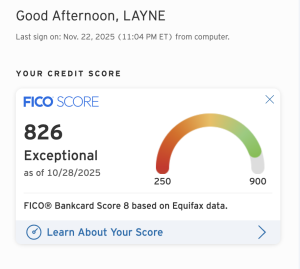
I opened my first travel credit card in 2008. I’ve been doing this for 17 years and, following the three simple rules above, my credit score is always above 800.
The Chase 5/24 Rule
Chase will generally deny your application for most of their credit cards if you’ve opened 5 or more personal credit cards (from any bank) in the last 24 months.
Since Chase has some of the strongest travel cards, plan your applications carefully.
With most card issuers, business cards do not count toward your Chase 5/24 status because they do not appear on your personal credit report. However, there are notable exceptions, including business cards from Capital One, Discover, and TD Bank.
Since these banks report business card activity to the cardholder’s personal credit report, they will count toward your 5/24 status.
SECTION EIGHT: THE DOWNSIDES OF CREDIT CARD TRAVEL HACKING
I love this system.
It’s taken me to 61 countries, mostly in business class, for absurdly small amounts of money.
But it’s not for everyone.
It requires some time and mental energy
Not a ton — but some.
You must manage your spending responsibly
This strategy fails instantly if you overspend.
Mistakes can erase your value
Booking through the wrong portal, paying interest, missing an award seat rule…
All can cost you hundreds, wiping out your savings without returning any time you invested.
This is why taking a structured course (like the Wanderluxed Travel Hacking Masterclass) saves people years of trial and error.
SECTION NINE: NEXT STEPS—START YOUR TRAVEL HACKING JOURNEY
If this guide helped you understand the basics of credit card travel hacking, and you’re ready to take the next steps, here’s where to go from here:
✅ Join the Wanderluxed mailing list
Get weekly strategies, mistake-proof guides, and real redemption opportunities.
✅ Follow Wanderluxed on social
Quick tips, news updates, and “deal alerts”-style reminders.
- Wanderluxed Facebook Page
- Wanderluxed Instagram Page
- Wanderluxed TikTok Page (not regularly updated)
✅ Take the Wanderluxed Burnout to the Beach mini-course
A 5-day introductory program that lays out my entire system, including how to find free and discounted places to stay all over the world—without spending any of your credit card points. You also get to watch over my shoulder while I book three different international beach trips!
✅ Enroll in the full Wanderluxed Travel Hacking Masterclass
The entire A–Z framework I use to:
- Travel in first and business class for the price of economy… and often far less
- Stay in beautiful homes all over the world for free
- Get half off luxury hotels
- Travel ethically and sustainably
The points and miles strategies taught in the masterclass are the ones explained in this article + additional strategies like gas station multipliers and how to earn miles instead of interest on your bank account.
By watching videos and working through structured assignments a few hours a week for a couple months, you’ll get completely acclimated to the travel hacking ecosystem.
The masterclass helps you put it on autopilot so that you can do this stuff in your sleep and rake in AT LEAST enough points for a nearly free vacation every single year for the rest of your life.